
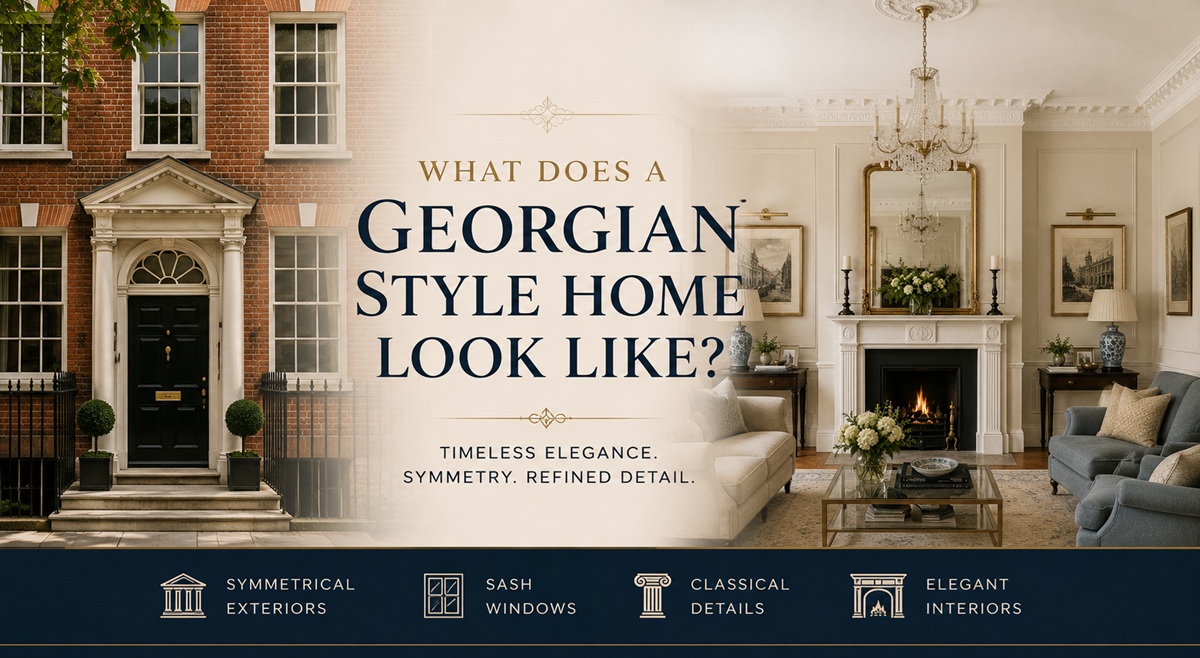
There is something quietly commanding about a Georgian home. It does not shout for attention. It simply stands there, perfectly balanced, with the kind of composed elegance that has made it one of the most enduring architectural styles in the world. If you have ever walked past a stately brick facade with evenly spaced windows, a handsome central door, and a roof that seems to sit exactly where it should, chances are you were looking at a Georgian home.
But what exactly defines this style? Whether you are buying a period property, renovating your home with a classical feel, or simply drawn to the aesthetic, this guide walks you through everything that makes a Georgian home look the way it does, from the front facade to the fireplace.
The Origins: Where Does Georgian Style Come From?
The Georgian style spans a long and influential period in architectural history, roughly from 1714 to 1830, coinciding with the reigns of the four British monarchs named George. It was an era shaped by the Age of Enlightenment, a time when reason, order, and proportion were valued above ornamentation and excess.
Architects of the period looked to Ancient Greece and Rome for inspiration, reviving classical forms and applying them to homes, townhouses, and public buildings. The Italian Renaissance architect Andrea Palladio was a major influence, and his emphasis on harmony and mathematical proportion became the backbone of Georgian design. The style crossed the Atlantic into the American colonies, where it evolved into the Federal style, and has continued to inspire architects and interior designers ever since.
What Does the Outside of a Georgian Home Look Like?
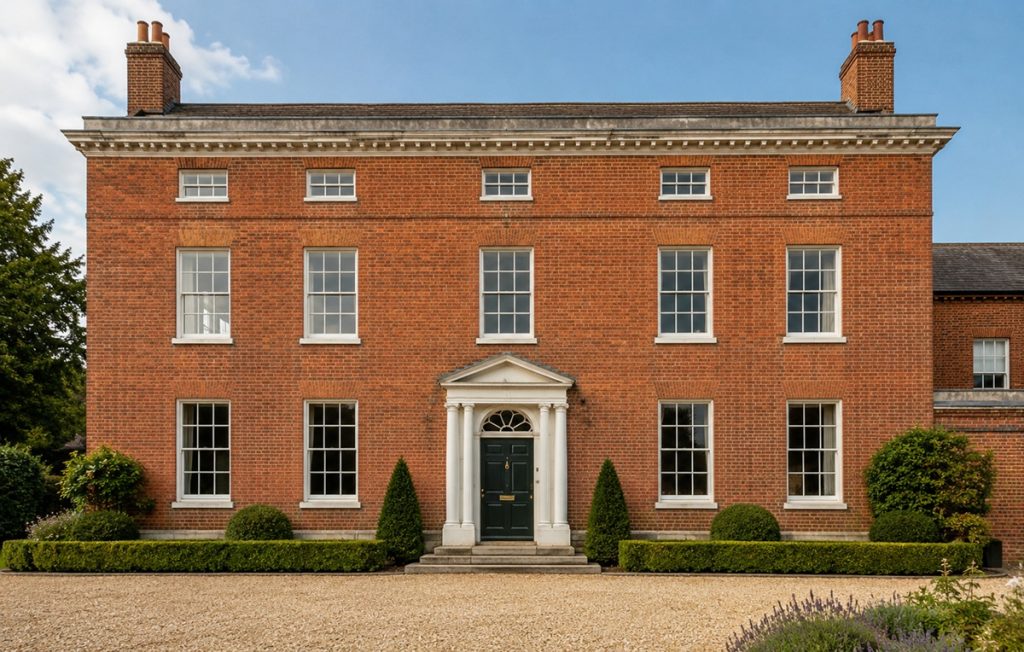
The Georgian exterior is defined above all else by symmetry. Every element on the facade has a counterpart. Windows mirror each other. Chimneys are placed to balance the roofline. Even the front door sits precisely at the centre of the building. This is not accidental. It reflects a deliberate philosophy: that a well-ordered home signals a well-ordered mind.
The Shape and Structure
Georgian homes are almost always square or rectangular, typically two or two-and-a-half stories tall and two rooms deep. The layout is straightforward and efficient, a quality that makes the style surprisingly adaptable to modern living. You will not find awkward extensions, unexpected angles, or cluttered rooflines on a true Georgian home.
The Facade and Materials
Red brick is the material most associated with Georgian architecture, particularly in Britain and the American mid-Atlantic states. In the northern colonies, wood clapboard or shingle cladding was more common, while stone and stucco appear in other regional variations. What remains consistent across all variations is the sense of solid, dignified permanence.
The Front Door
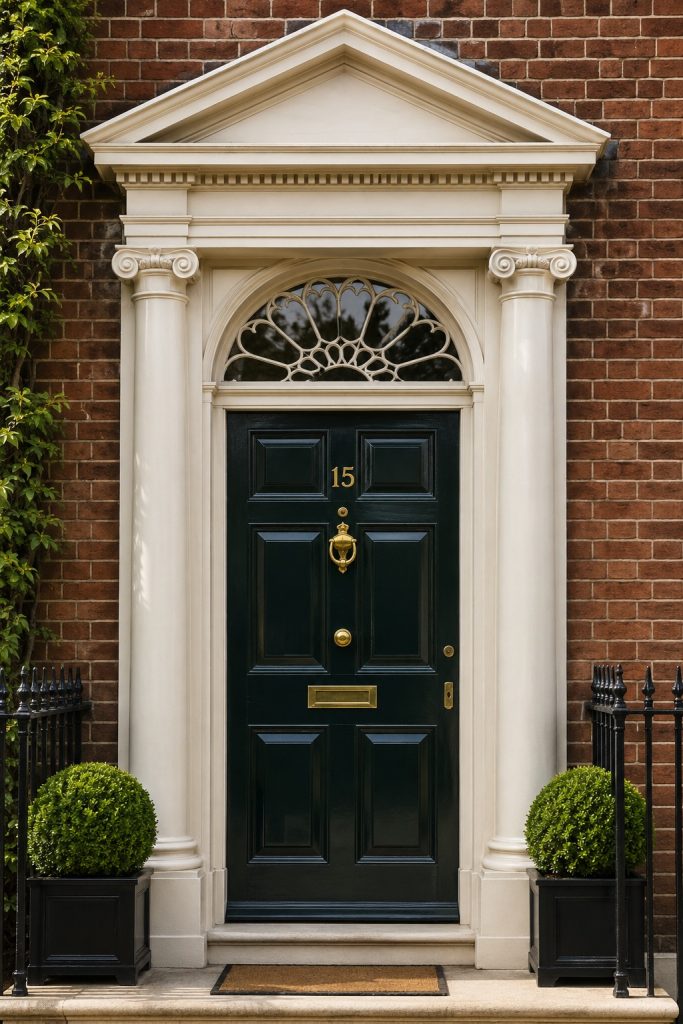
The front door of a Georgian home is its centrepiece, and it is designed to make an impression. It typically sits at the exact centre of the facade, flanked by two sash windows on each side. The door surround often features pilasters (flat columns), a pediment or arched canopy above, and a fanlight window that draws natural light into the hallway. Many Georgian doors also have glazed sidelights. The overall effect is formal but welcoming.
The Windows
Georgian windows are one of the most recognisable features of the style. They are large, double-hung sash windows with multiple small panes, typically in a 9-over-9 or 12-over-12 configuration. They appear in rows of three, five, or seven across the facade, always evenly spaced, and are taller than they are wide. On upper floors, windows are slightly smaller than those below, adding to the sense of classical proportion without disrupting the symmetry.
The Roof
Georgian roofs come in three main forms: hipped roofs that slope down on all four sides, side-gabled roofs that pitch to the front and back only, and gambrel roofs that feature two different slope angles. Dormers are common, adding light to upper floors without disrupting the clean lines of the exterior. Chimneys are placed symmetrically, most often in pairs, reinforcing the balanced visual language of the style.
What Does a Georgian Interior Look Like?
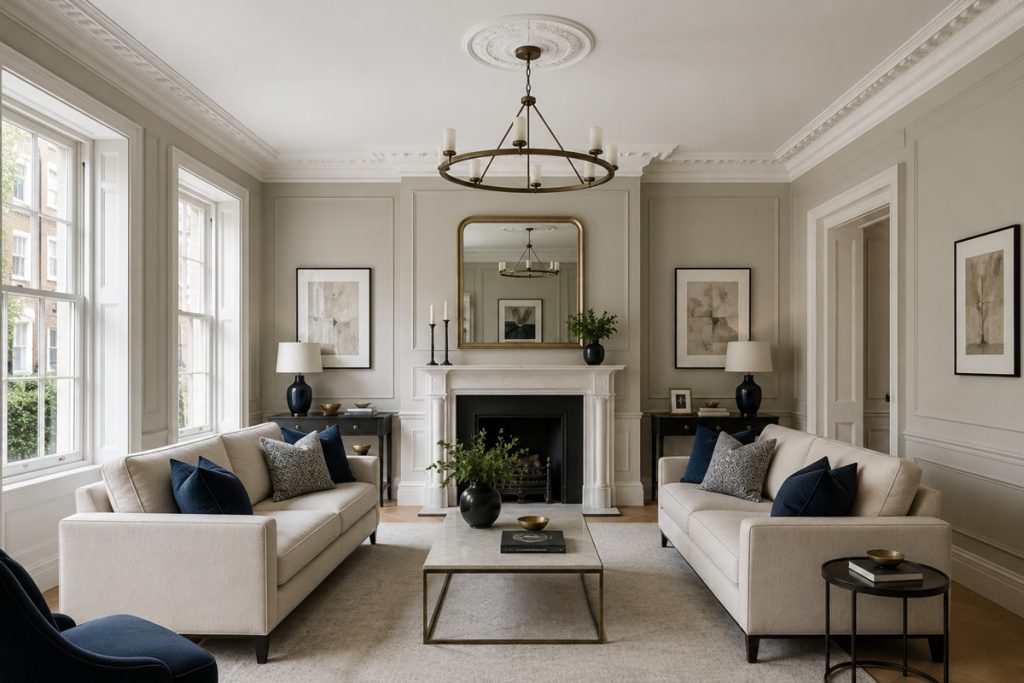
Step inside a Georgian home and the same principles that govern the exterior carry through to every room. The interior is ordered, balanced, and refined, but it is far from cold. When done well, a Georgian interior feels like a place where every object has been considered and every room has a clear purpose.
High Ceilings and Generous Proportions
Georgian rooms are designed with height and light in mind. Ceilings are tall, typically around 10 to 12 feet on the ground floor, and rooms are rarely more than 20 feet deep, a deliberate choice to prevent spaces from feeling dark or oppressive. Large sash windows flood the interior with natural daylight. The result is a feeling of spaciousness and calm that modern open-plan living often struggles to replicate.
The Hallway and Staircase
In a Georgian home, the hallway is not just a passageway. It is a statement of intent. The formal entrance leads into a well-proportioned hall, often featuring a grand staircase positioned slightly to one side, with elegantly turned balusters and a sweeping handrail. This central staircase connects the floors in a way that feels ceremonial without being ostentatious. It is the spine of the home.
Wall Treatments and Mouldings
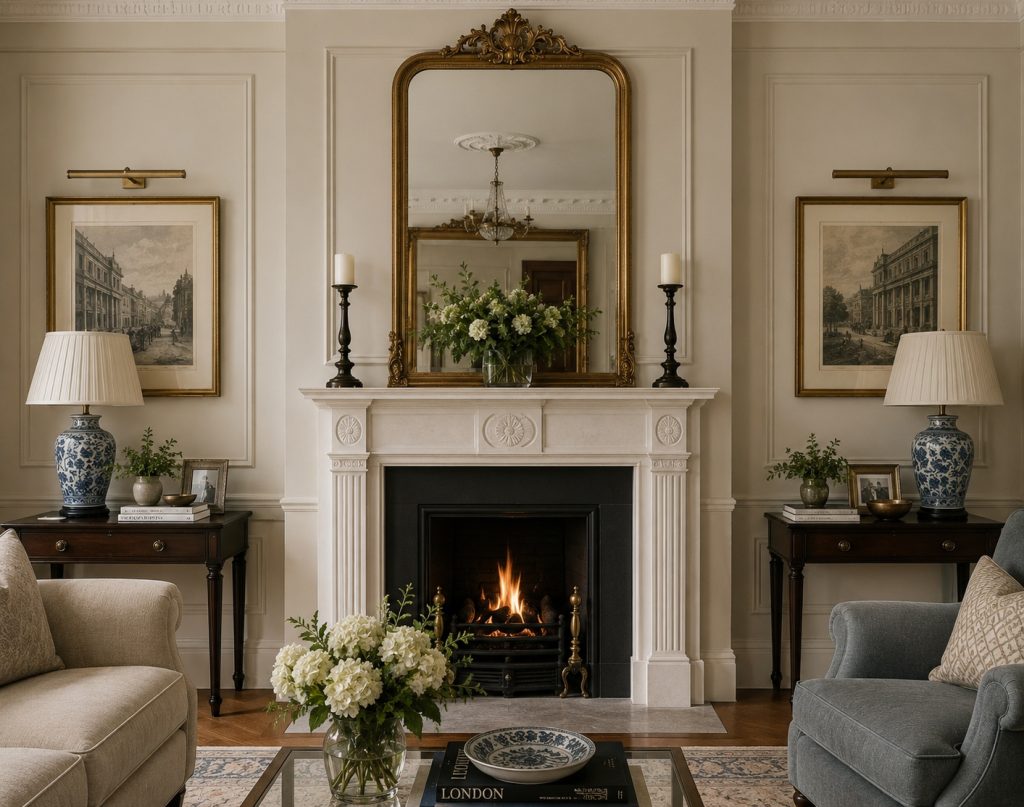
Georgian walls are never plain. They are either fully panelled in wood, or divided into a lower panelled section (the dado) and a plastered or papered upper half. Where wallpaper is used, patterns are restrained: geometric designs, botanical prints, and chinoiserie-influenced motifs all fit the Georgian aesthetic. Crown mouldings, cornices, and plaster ceiling roses add architectural interest without cluttering the space. These details are what give Georgian interiors their sense of depth and craftsmanship.
The Fireplace as a Focal Point
Every significant room in a Georgian home has a fireplace, and it is always the focal point of that room. The mantelpiece is typically the most decorative element in an otherwise restrained space, featuring intricate mouldings, classical motifs, and a well-proportioned surround. Furniture is arranged symmetrically around it, reinforcing the sense of order. A Georgian fireplace is not just a source of warmth. It is the anchor of the room.
Georgian Colour Palettes: What Colours Work?
Georgian interiors are not white boxes. The palette is restrained but warm, drawing on pigments that would have been available in the 18th and 19th centuries. Think soft sage greens, dusty blues, warm ochres, stone beiges, dove greys, and deep burgundies for accent walls or formal rooms. These are not muted colours in the modern minimal sense. They have depth and character, and they work with the architectural details rather than competing with them.
For a contemporary Georgian look, softer versions of the same palette translate well. Pale blues and greens on panelled walls, warm off-whites for ceilings and mouldings, and richer tones in libraries or dining rooms remain just as compelling today as they were three centuries ago.
Georgian Furniture: What to Look For
Georgian furniture is crafted for both beauty and function. The most prized pieces come from the workshops of cabinetmakers like Thomas Chippendale and George Hepplewhite, who favoured fine woods including mahogany, walnut, and satinwood. Key pieces to look for include:
- Wingback chairs and upholstered armchairs in velvet, silk, or brocade
- Cabriole-legged side tables and console tables
- Breakfront bookcases and display cabinets
- Four-poster beds with canopy frames in formal bedrooms
- Pedestal desks and writing tables in libraries or studies
- Gilt-framed mirrors, particularly above fireplaces
Proportion matters as much as style. Georgian furniture is scaled to fit its room, never oversized, never understated. If a piece feels too heavy for the space, it is probably not the right choice.
How Is a Georgian Home Different From Colonial or Victorian?
These three styles are often confused, and understandably so. They overlap in period and share some features. Here is the key distinction: Georgian is about restraint and classical order. Victorian, which came after, embraces far more ornamentation, asymmetry, and variety of detail. A Victorian home tends to feel busier, with bay windows, decorative bargeboard, and richly patterned interiors. A Georgian home, by contrast, is calm and composed.
Colonial architecture is a broader category that includes Georgian alongside other styles such as Dutch Colonial and Spanish Colonial. Georgian is the most formal and symmetrical expression within the colonial tradition, and it is typically distinguished by its larger scale, more refined detailing, and stricter adherence to classical proportion.
Can You Bring Georgian Style Into a Modern Home?
You do not need a period property to live with Georgian style. The principles that make this aesthetic so enduring, symmetry, proportion, restrained elegance, and a commitment to craftsmanship, translate naturally into contemporary interiors. Here is where to start:
- Add crown mouldings and coving to plain ceilings
- Install or restore sash-style windows if original ones have been replaced
- Panel a wall or add dado rails for instant Georgian character
- Choose a statement fireplace as the room’s focal point
- Arrange furniture symmetrically around a central axis
- Use a Georgian-inspired colour palette: sage, slate blue, warm cream, deep burgundy
- Invest in a few quality wooden pieces rather than filling the room with furniture
Frequently Asked Questions
What makes a home Georgian style?
A Georgian home is defined by its strict symmetry, rectangular or square shape, centred front door, evenly spaced sash windows, and classical detailing such as pediments and mouldings. Both the exterior and interior follow the same principle of balance and proportion.
What colours are used in Georgian style homes?
Georgian interiors favour restrained, elegant palettes. Common choices include soft blues, sage greens, muted pinks, warm creams, and dove greys. Darker tones like deep burgundy and navy were also used in formal rooms. The overall effect is sophisticated without being loud.
Is Georgian style the same as colonial?
They are closely related but not identical. Colonial architecture broadly refers to the building styles of the American colonies, while Georgian is a specific classical style within that period. Georgian homes are typically larger, more formally detailed, and more strictly symmetrical than simpler colonial designs.
Can I add Georgian style to a modern home?
Yes. You do not need a period property to bring Georgian elegance into your space. Key elements like crown mouldings, panelled walls, sash-style windows, a statement fireplace, and symmetrical furniture arrangements can all be introduced into a modern home to capture the Georgian aesthetic.
What furniture suits a Georgian style interior?
Georgian interiors pair best with furniture crafted from rich woods like mahogany and walnut. Look for wingback chairs, cabriole-legged tables, breakfront bookcases, and upholstered pieces in velvet or brocade. Clean lines and careful proportions matter more than heavy ornamentation.
Final Thoughts
A Georgian home is one of the rare architectural styles that genuinely improves with age. Its logic is simple but profound: when a space is well-proportioned, symmetrical, and free from clutter, it tends to feel right. Not fashionable for a season, but deeply, lastingly right. Whether you are admiring a Georgian townhouse from the street, restoring a period property, or simply borrowing elements for a modern interior, the principles are always the same. Order, balance, and the quiet confidence that comes from knowing exactly where everything belongs.