
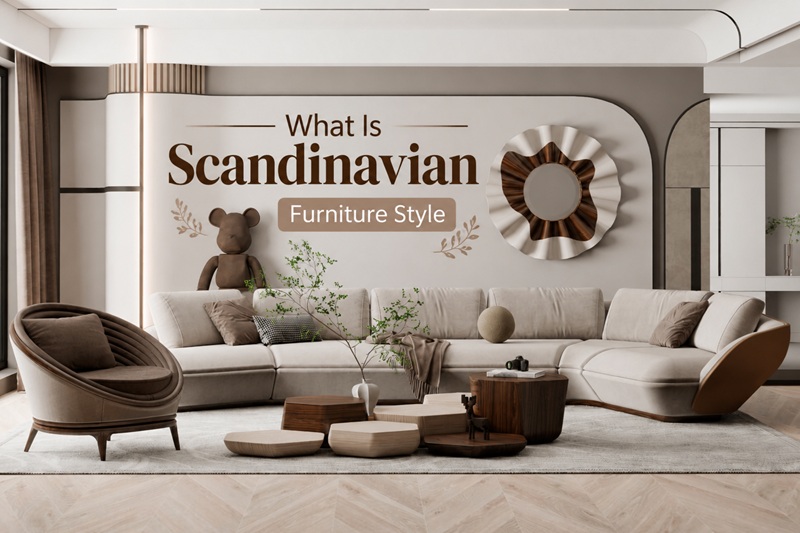
Few design movements have had as lasting and far-reaching an influence on how people furnish and live in their homes as Scandinavian design. From the chairs that appear in the background of every architectural photograph to the pale timber floors and white walls that have become the default aspiration of modern interiors worldwide, the visual language of Nordic design is everywhere — often recognised immediately but rarely understood in terms of where it came from, what it actually means, and why it continues to feel relevant decades after it first emerged.
This guide covers the full picture of Scandinavian furniture style: its origins in the Nordic countries of Denmark, Sweden, Norway, Finland, and Iceland, its defining principles, the materials and colour choices that characterise it, the iconic designers and pieces that shaped it, and how to bring its philosophy into a home today — including how it sits alongside, and sometimes within, the character of period interiors.
Where Scandinavian Design Came From
Scandinavian design is a movement that emerged in the early 20th century and reached its peak of international influence in the 1950s — a period now widely referred to as the golden age of Nordic design. Its origins lie in a set of geographic and cultural conditions specific to the Nordic countries that shaped not just how furniture looked but what it was expected to do.
The Nordic climate is the most fundamental influence. Long winters with very limited daylight hours made the quality and feel of interior spaces a matter of genuine daily importance. Homes needed to feel warm, bright, and restorative because they were where people spent the majority of their time during months when the outdoors was dark and cold. This practical pressure produced an interior aesthetic built around maximising available light, creating physical warmth through material and textile choices, and making the home a genuinely comfortable environment rather than simply a functional one.
The democratic ideals of mid-20th century Nordic social culture also shaped the movement profoundly. The design establishment in Denmark, Sweden, and Finland was committed to the idea that well-designed, beautifully made objects should be available to everyone, not reserved for those who could afford luxury goods. This commitment to democratic design — producing quality pieces at accessible prices through thoughtful use of materials and manufacturing — is what gave Scandinavian furniture its particular character: refined without being precious, handsome without being expensive to produce.
An early milestone was the launch of Denmark’s Skønvirke magazine in 1914, which helped promote accessible decorative arts and craftsmanship. The Stockholm Exhibition of 1930 introduced the principles of functionalism to a wider Scandinavian audience, while the 1954 traveling exhibition Design in Scandinavia — which toured the United States and Canada until 1957 — brought the movement to international prominence for the first time. By the late 1950s, Scandinavian Modern furniture was a recognised style in America and across Europe, and names like Hans Wegner, Arne Jacobsen, and Alvar Aalto had become internationally known.
The Core Principles of Scandinavian Furniture Style
Understanding the principles behind Scandinavian furniture style is more useful than cataloguing its visual characteristics, because the principles explain why the style looks the way it does and how to apply it meaningfully rather than superficially.
Functionality as the Starting Point
The central principle of Scandinavian design is that every object should serve a clear purpose, and that purpose should be served well. This is not the functional minimalism of an office or a factory — it is a commitment to the idea that daily life is improved when the objects that fill it work properly. A chair that is comfortable to sit in for several hours, a table that is the right height for the people who use it, a storage piece that makes organisation effortless — these are the outcomes that Scandinavian design aims for first.
This means that decorative elements in Scandinavian furniture are almost always the result of solving a functional problem beautifully rather than adding ornament for its own sake. The curved back of a Wegner chair is not decoration — it is the most comfortable shape for a human back. The tapered legs on a mid-century Nordic sideboard are not affectations — they lift the piece visually, make cleaning underneath it easier, and allow the eye to travel through to the floor behind, keeping the room feeling open. Every detail has a reason.
Simplicity and the Elimination of the Unnecessary
Scandinavian design avoids unnecessary ornament. Not because ornament is inherently wrong, but because anything that does not contribute to the function or the essential form of an object is considered a distraction. The result is furniture that is visually quiet — it does not demand attention or compete with the room around it. It takes its place in the space and allows the room, the light, and the people in it to be the primary experience.
This restraint is often described as minimalism, but it is a specific and warm form of minimalism that should not be confused with the cold, clinical emptiness that the word sometimes implies. Scandinavian spaces are restrained but not bare. The restraint is in the number of objects and the absence of unnecessary detail, not in the absence of material warmth, texture, or personality.
Harmony with Nature
Scandinavian design maintains a consistent relationship with the natural world — not as a stylistic reference but as a practical and philosophical commitment. Natural materials are preferred over synthetic ones because they are warmer to the touch, age more gracefully, and connect the interior to the outdoor environment in a way that manufactured materials cannot. Wood, wool, linen, leather, stone, and ceramics are the primary material vocabulary of the style.
This connection to nature also shows up in the colour palette, which draws from the Nordic landscape: the grey of a winter sky, the pale gold of birch bark, the soft green of lichen on stone, the deep blue of a northern lake. These are not colours chosen for trend but colours that feel inherently calm and right in spaces designed for rest and everyday life.
Hygge and Lagom: The Philosophy Behind the Look
Two Scandinavian concepts underpin the feel of Nordic interiors and help explain why Scandinavian rooms feel different from merely minimalist ones.
Hygge is a Danish and Norwegian concept that describes a quality of cosiness, ease, and contentment — the feeling of being in a warm, comfortable, well-lit space with people you care about, or quietly alone with a good book. It is not a decorating style but a feeling, and Scandinavian interiors are designed to produce it. Soft lighting at multiple levels, warm textiles, comfortable seating, and the materials and colours of the natural world all contribute to hygge. A Scandinavian room that achieves hygge is not just aesthetically pleasing — it actively feels good to be in.
Lagom is a Swedish concept that roughly translates as “just the right amount” — not too much, not too little, but exactly enough. In design terms, it describes the Scandinavian instinct for balance and proportion. A room with lagom has enough furniture to be comfortable and functional without feeling crowded. It has enough decoration to feel personal and warm without feeling cluttered. It has enough colour to have character without the palette becoming chaotic. Lagom is the principle that explains why Scandinavian rooms feel effortlessly right rather than the product of deliberate restraint.
Materials in Scandinavian Furniture
The material choices of Scandinavian furniture are among its most recognisable and consistent characteristics.
Wood
Wood is the dominant material of Scandinavian furniture and the one most closely associated with the style. Light woods are preferred over dark: birch, ash, beech, pine, and oak in its paler varieties are the most commonly used. These light wood tones reflect available light, keep the furniture from feeling heavy, and relate naturally to the pale walls and neutral palette of a Scandinavian interior.
The treatment of wood in Nordic furniture respects the material’s natural character. Wood grain is visible rather than concealed under opaque paint or heavy lacquer. The forms are shaped to work with the wood’s natural strength and flexibility rather than against it. The chairs of Hans Wegner in particular demonstrate this relationship — the curved wooden forms of the Wishbone Chair and the Round Chair are shaped the way they are because wood bends and holds in those directions, and the resulting forms are among the most beautiful produced in 20th-century furniture design.
Darker woods appear in Scandinavian furniture, but typically as contrast accents rather than dominant materials — walnut used for legs while a lighter wood handles the main body, or teak used for a sideboard surface where its grain and warmth are the primary visual feature.
Wool and Textile
Textiles are the primary source of warmth and tactile richness in a Scandinavian interior. Wool — in throws, cushion covers, rugs, and upholstery — is the most characteristically Nordic textile choice, reflecting both the climate and the long Scandinavian tradition of textile craft. Linen and cotton appear extensively in lighter weights for cushion covers, curtains, and bedding. Sheepskin and reindeer hide, used as seat pads and floor coverings, bring an immediately Nordic character to a room.
The pattern tradition in Scandinavian textiles is a rich and distinctive one — geometric forms, folk-inspired motifs, and the bold graphic patterns associated with Finnish design house Marimekko all have their roots in Nordic craft history. These patterns appear in accessories and textiles rather than as the primary wallpaper or fabric of the room, functioning as animated accents within an otherwise calm palette.
Stone and Ceramics
Stone surfaces appear in Scandinavian interiors primarily in kitchens and bathrooms, where the material’s durability and natural beauty suit the functional demands of those spaces. Slate, limestone, and soapstone all have precedent in Nordic domestic architecture. Ceramic tiles in simple geometric patterns, often in white or off-white with a matte finish, are a common feature of Nordic kitchens.
Handmade ceramics are among the most distinctive objects in Scandinavian interior styling. A simple thrown pot, a textured stoneware vase, a set of hand-glazed bowls — these objects bring the material quality and human touch that Scandinavian design values in an accessible and affordable form. The Scandinavian ceramics tradition, particularly from Finland and Denmark, is one of the strongest in European design history.
The Scandinavian Colour Palette
The colour palette of Scandinavian interiors is frequently described as neutral, but that description undersells its sophistication. The palette is tonal and carefully considered — built from colours that relate naturally to each other and to the materials and light of Nordic environments.
White is the most fundamental Scandinavian interior colour, used on walls and ceilings to maximise the reflection of natural light. But it is rarely a stark, brilliant white — the most characteristic Scandinavian whites are warm, with a slight yellow or grey undertone that prevents the colour from feeling cold or clinical. Off-white, cream, and chalk white all sit within this family.
Soft greys form the most common neutral accent, used in upholstery, rugs, and architectural details. They range from a cool blue-grey that references the Nordic winter sky to a warmer stone grey that sits close to the white palette without merging with it.
Pale wood tones — the natural colours of birch, beech, and ash — function as the third colour in most Scandinavian interiors, bringing warmth and organic reference to spaces that would otherwise be purely mineral in feel.
Accent colours in Scandinavian interiors are typically drawn from nature and used sparingly. Dusty blue and sage green are the most classically Nordic accent choices, referencing the sea and the forest. Terracotta, ochre, and rust appear more in contemporary Nordic styling and in the Finnish design tradition particularly. Black is used as a graphic accent — in lamp shades, picture frames, and furniture legs — to provide definition without introducing chromatic complexity.
Iconic Designers and Pieces
The Scandinavian design canon is populated by a relatively small number of designers whose work defined the movement and whose pieces remain in production decades after they were first created.
Hans Wegner (Denmark, 1914 to 2007)
Wegner is the designer most closely associated with the Scandinavian chair tradition. His output over a career spanning more than half a century was prodigious — over 500 chair designs — and several of them have become defining objects of 20th-century design. The Wishbone Chair (1950), with its Y-shaped back and woven seat, has sold over one million units and remains in continuous production by Carl Hansen and Son. The Round Chair (1949), which a 1950 American magazine simply called “The Chair,” is widely considered one of the most beautiful chairs ever made. The Shell Chair (1963), with its organic, sculptural form, demonstrates that Scandinavian furniture was never only about rectilinear simplicity.
Arne Jacobsen (Denmark, 1902 to 1971)
Jacobsen was primarily an architect who designed furniture to complete his buildings, and the discipline of that approach is evident in his most famous pieces. The Egg Chair (1958), designed for the SAS Royal Hotel in Copenhagen, is an enveloping organic form that provides privacy and comfort in a public setting. The Swan Chair (1958) is a slimmer, more open companion piece. The Ant Chair (1952), Jacobsen’s first plastic chair design, was revolutionary in its use of material and in the economy of its form — four legs, a single moulded seat-and-back shell, and nothing else.
Alvar Aalto (Finland, 1898 to 1976)
Aalto was the dominant figure of Finnish design and one of the most important architects of the 20th century. His furniture, produced by his company Artek, is distinguished by its use of bent birch plywood — a technique he developed and refined over decades. The Paimio Chair (1932), designed for a tuberculosis sanatorium, used the flexibility of bent plywood to create a chair that was easier to clean and more comfortable for recovering patients. The Stool 60 (1933), a three-legged stacking stool with a simple circular seat, is one of the most reproduced pieces of furniture in history.
Poul Henningsen (Denmark, 1894 to 1967)
Henningsen’s contribution to Scandinavian design was primarily in lighting rather than furniture, but his work is inseparable from the Scandinavian interior. The PH Artichoke lamp (1958), designed for a Copenhagen restaurant, is a luminaire of extraordinary complexity — 72 individual leaves arranged to provide soft, glare-free light from every angle. His PH lamp series, begun in the 1920s, addressed the same problem with greater economy of means. In a design tradition defined by its commitment to improving daily life, Henningsen’s work on light quality is among the most consequential.
Verner Panton (Denmark, 1926 to 1998)
Panton represents the more experimental and exuberant strand of Scandinavian design — one that used new materials and bold colour to push beyond the restrained palette most associated with the movement. The Panton Chair (1968), the first single-material, single-piece plastic chair, was a landmark of industrial design. His colour experiments, bold textiles, and unconventional forms introduced a playfulness into Nordic design that distinguished Danish design specifically from the quieter Scandinavian mainstream.
Scandinavian Furniture Style Room by Room
The Living Room
The Scandinavian living room is built around a sofa with clean lines and natural upholstery — linen, cotton, or wool — positioned to make the most of natural light. A pale timber floor, possibly with a textured wool or cotton rug to define the seating area, provides the base. A single pendant light of quality, along with table lamps and floor lamps at lower levels, creates the layered lighting essential to a hygge atmosphere. Objects on shelves and surfaces are few and carefully chosen — a ceramic vase, a framed print, a stack of books. The room is comfortable and personal rather than dressed for display.
The Dining Room
Scandinavian dining rooms prioritise social connection and everyday use over formality. A solid wood dining table with simple legs — oval or round forms suit smaller spaces — is the centrepiece. Chairs are lightweight visually: the Wishbone Chair, the Ant Chair, or a simple ladder-back chair in pale timber. A statement pendant light over the table is one of the most characteristic elements of a Nordic dining room — the PH Artichoke, a cluster of simple glass pendants, or a modern equivalent in ceramic or metal. The table is set simply, with ceramics and linen rather than ornate tableware.
The Bedroom
The Scandinavian bedroom is restrained. It prioritises rest and asks for nothing demanding visually. A bed with a simple timber frame or an upholstered headboard in linen or wool sits centrally, dressed in white or off-white bedding with a wool or cotton throw for texture. Bedside tables are simple — a small timber stool, a ceramic lamp with a linen shade. Storage is built-in where possible to keep surfaces clear. A single plant, a small stack of books, and one or two considered objects are the limit of the decoration. The result is a room that asks nothing of the mind and allows the body to rest.
How Scandinavian Furniture Sits in Period Interiors
One of the more interesting questions for homeowners in Georgian or Victorian properties is how Scandinavian furniture relates to the architectural character of a period room. The conventional design wisdom has sometimes suggested that the styles conflict — that the ornate cornicing and sash windows of a Georgian bedroom are incompatible with the clean lines of Nordic furniture.
In practice, the combination often works better than either approach used alone. Georgian and Scandinavian design share a respect for proportion, craftsmanship, and the quality of materials. Both traditions value things made well over things made decoratively. The contrast between the formal architectural character of a Georgian room — its plasterwork, its sash windows, its marble fireplace — and the organic warmth of a Wishbone Chair or a birch-topped dining table is productive rather than dissonant. The period room provides structure and history; the Nordic furniture provides ease and warmth.
The practical approach is to retain and highlight the period architecture of the room — do not remove or cover cornicing, picture rails, fireplaces, or original doors — and introduce Scandinavian furniture with restraint. A pale timber dining table in a Georgian dining room with original plasterwork and a Poul Henningsen pendant above it is not a compromise between two styles. It is a room that uses the best of both.
Why Scandinavian Furniture Style Endures
The lasting relevance of Scandinavian design is not difficult to explain. It is a style built on principles rather than trends, and principles do not date. The commitment to quality materials that age gracefully, to forms shaped by function rather than fashion, and to the creation of interiors that feel genuinely good to live in — these are values that do not go out of style because they were never in style in the first place. They are simply true.
In an era of fast furniture and disposable interiors, the Scandinavian tradition of buying fewer, better things and living with them for decades has a particular contemporary relevance. A Hans Wegner chair bought in the 1960s looks as beautiful and works as well today as it did when it was made. The same cannot be said of most furniture produced in the decades since.
That is the most honest answer to the question of what Scandinavian furniture style is. It is design built for a life well lived — simple, warm, honest, and made to last.