
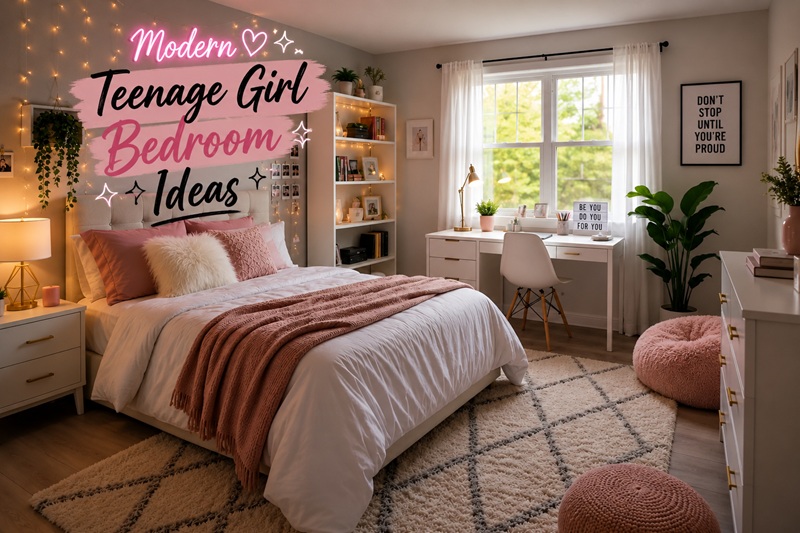
A teenage girl’s bedroom is one of the most demanding design briefs in the home. It needs to function as a sleeping space, a study zone, a place to socialise, a personal sanctuary, and an expression of identity — all within what is usually a modest amount of square footage. It also needs to be designed for someone whose tastes are evolving rapidly, whose priorities will shift year on year, and who has strong and specific opinions about what she wants the room to feel like.
The best modern teenage girl bedrooms balance all of these demands without sacrificing any of them. They are functional enough to support daily life, flexible enough to evolve over time, and personal enough to feel genuinely hers rather than a generic room dressed with a few trending accessories.
This guide covers every dimension of designing a modern teenage girl bedroom — from the first decisions about layout and colour to the finishing details that give a room its character.
What Are the Key Differences Between a Child’s Bedroom and a Modern Teen Bedroom?
The transition from a child’s bedroom to a teenage girl’s bedroom is more than a change of colour palette or the removal of toys. It represents a fundamental shift in what the room is for and how it needs to function.
A child’s bedroom is primarily a sleeping space with room for play. A teenage girl’s bedroom is a multi-purpose private space that needs to accommodate sleep, study, socialising, creative expression, and the kind of quiet personal time that adolescence increasingly requires. The room becomes a retreat from the shared spaces of the home — somewhere she can close the door, control her environment, and exist on her own terms.
This shift in function drives every subsequent design decision. Furniture needs to support study as seriously as it supports rest. Storage needs to accommodate a growing wardrobe, a collection of books, art supplies, sports equipment, or whatever else reflects her particular interests. Lighting needs to work for tasks as well as for atmosphere. And the room’s visual identity needs to feel personal and self-chosen rather than appointed by parents.
The most effective modern teen girl bedrooms are designed with the teenager’s input at every stage. Not as a veto on every decision, but as a genuine collaboration that ensures the room reflects her taste rather than an adult’s idea of what a teenage girl should like.
What Colour Palettes Work Best for a Modern Teenage Girl Bedroom?
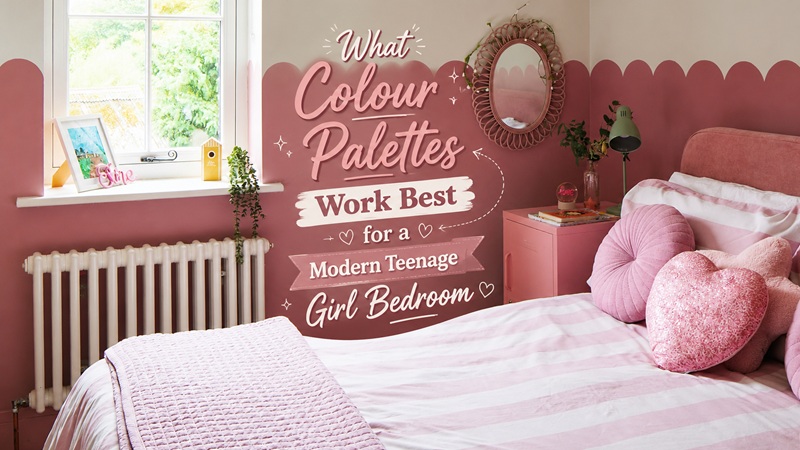
Colour is where most teenage bedroom redesigns begin, and it is one of the decisions with the most impact on how the finished room feels.
The dominant trend in teenage girl bedrooms is a move away from the bright, primary pinks and purples of childhood rooms toward more sophisticated, muted versions of similar hues — dusty rose rather than hot pink, lavender rather than bright purple, sage green rather than lime. These colours retain the warmth and personality of the brighter originals while reading as considerably more grown-up and easier to live with over time.
Neutral palettes with warm undertones are equally popular for teenage girls who prefer a calmer aesthetic — warm whites, soft creams, honey beige, and greige (grey-beige) all provide a flexible base that can be personalised through bedding, artwork, and accessories without requiring a repaint every time tastes change. The HGTV Smart Home 2026 teen bedroom demonstrated how effectively soft pink tones and layered patterns can work within a broadly neutral architectural shell.
For teenage girls who want something bolder, deep tones have become a strong current option — forest green, dusty navy, warm terracotta, and graphite lilac all appear in current teenage bedroom design. These colours add depth and sophistication to a room and work particularly well on a single feature wall paired with lighter surrounding walls, which gives the room impact without the commitment of painting the entire space in a saturated tone.
The most practical approach to colour in a teenage bedroom is to use paint on the walls as a relatively permanent backdrop and invest the personality in more easily changed elements — bedding, cushions, artwork, and curtains — so that the room can evolve without requiring a full redecoration each time her tastes shift.
What Furniture Does a Modern Teenage Girl Bedroom Need?
The furniture selection for a teenage girl’s bedroom needs to balance three things: sleeping, studying, and storage. Getting all three right in what is usually a compact room requires deliberate choices.
What Is the Best Bed for a Teenage Girl’s Bedroom?
The bed is the dominant piece of furniture in any bedroom and the one that sets the tone for the entire room. For a teenage girl, a bed with a statement headboard is one of the most effective single investments available. An upholstered headboard — in velvet, linen, or a bouclé fabric — immediately elevates the bed and makes it the visual centre of the room.
Scalloped headboards, arched headboards, and panel headboards in soft, curved forms are particularly popular in current teenage bedroom design, reflecting a broader trend toward organic shapes and tactile materials that make the bed feel less functional and more like a designed piece of furniture.
For rooms with limited floor space, a bed with built-in storage underneath — drawers or a lift-up base — is one of the most efficient uses of space available, eliminating the need for a separate chest of drawers in smaller rooms.
A four-poster frame, even a slim, modern interpretation in brushed metal or pale timber, adds a canopy-ready architectural element to the bed that significantly changes the character of the room. Draped with lightweight linen, voile, or fairy lights, a four-poster creates the sense of an enclosed personal space within the bedroom that many teenagers find particularly appealing.
How Should a Study Area Be Designed in a Teen Bedroom?
A well-designed study area is one of the most important and most frequently underestimated elements of a teenage girl’s bedroom. Teenagers spend a significant number of hours studying in their rooms, and a poorly designed desk setup — too small, poorly lit, uncomfortably seated — affects both the quality of their work and the amount of time they are willing to spend doing it.
The desk should be large enough to accommodate a laptop, books, and writing materials simultaneously without feeling crowded. A surface of at least 120 centimetres in width is the practical minimum for comfortable study. The desk chair should be properly ergonomic — height adjustable, with back support — rather than chosen purely for aesthetic reasons. A beautiful but uncomfortable chair will be replaced within a month by the floor, which is not an improvement.
Positioning the desk beside or facing a window is ideal, providing natural light for daytime study and reducing eye strain. A dedicated desk lamp for evening use — adjustable, with a warm to neutral colour temperature — is as important as the overhead lighting of the room.
Shelving above or beside the desk creates organised storage for books, stationery, and personal objects that would otherwise accumulate on the desk surface itself. Floating shelves above the desk are a space-efficient choice; a bookcase to one side of the desk creates a more defined study zone and provides considerably more storage capacity.
What Storage Solutions Work Best in a Teen Girl’s Bedroom?
Storage in a teenage girl’s bedroom needs to be both generous and organised. The combination of a growing wardrobe, a collecting impulse that typically expands through the teenage years, and the general accumulation of books, art, sports equipment, and personal objects means that insufficient storage produces a chronically untidy room regardless of how well everything else is designed.
A wardrobe large enough to accommodate her actual wardrobe — not a theoretical minimum — is the starting point. Fitted wardrobes along one wall, reaching to ceiling height, provide the maximum storage in the minimum floor footprint. Where fitted wardrobes are not possible, a combination of a freestanding wardrobe and a chest of drawers typically provides sufficient capacity, though it uses more floor space.
Under-bed storage, whether in drawers built into the bed frame or in rolling bins tucked beneath it, adds a useful secondary storage zone for seasonal items, spare bedding, or infrequently accessed possessions.
Open shelving on the walls serves a dual purpose in a teenage bedroom: it provides accessible storage for books and everyday objects while also functioning as a display surface for the personal objects — photographs, plants, ceramics, collected items — that give the room its individual character.
What Are the Most Popular Aesthetic Styles for Modern Teen Girl Bedrooms?
Teenage bedroom aesthetics have become considerably more defined and deliberately chosen in recent years, driven in part by the influence of platforms where visual design references are widely shared and discussed. Understanding the main aesthetic categories helps clarify what a given teenager actually wants her room to feel like.
What Is the Soft Glam Aesthetic for Teen Bedrooms?
Soft glam is one of the most consistently popular aesthetic directions for teenage girl bedrooms. It combines the warmth and luxury of traditional glamour — velvet, metallic accents, mirrored surfaces, layered textiles — with the restrained sophistication of a modern neutral palette. The result is a room that feels special and grown-up without tipping into the kind of overtly ornate decoration that dates quickly.
A scalloped velvet headboard in blush, dusty rose, or cream is the centrepiece of a soft glam bedroom. Layered bedding — a quilted coverlet, European pillowcases, a decorative bolster, and a cashmere or velvet throw — creates the plush, textured surface that defines the style. Warm metallic accents in brushed gold or antique brass appear in light fittings, mirror frames, and drawer handles. A vanity table with a well-lit mirror is a characteristic soft glam addition that also serves a genuine practical function.
What Is the Minimalist or Neutral Aesthetic for Teenage Bedrooms?
For teenage girls who prefer a calmer, less decoratively intense environment, the minimalist or neutral aesthetic produces bedrooms that feel restful and intentional rather than styled. The palette is warm rather than cold — cream, linen, honey beige, warm white — and the furniture is simple in form but good in quality.
The minimalist teen bedroom is distinguished by what it does not contain as much as what it does. Surfaces are clear rather than decorated. Storage is concealed rather than open. The bed is simply dressed in high-quality plain bedding. The artwork, if present, is a single large piece rather than a gallery wall. This aesthetic suits teenagers who find visual complexity draining and who value their bedroom as a calm retreat from the stimulation of daily life.
What Is the Boho or Eclectic Aesthetic for Teen Girl Bedrooms?
The boho or eclectic aesthetic is the most relaxed and personalised of the main teenage bedroom styles. It is defined by layering — of textures, patterns, cultural references, and collected objects — in a way that feels accumulated over time rather than designed in a single session.
Rattan furniture, macramé wall hangings, tapestries, patterned rugs layered over each other, fairy lights, plants, and a gallery wall of mixed artwork and photography are characteristic elements. The colour palette is warmer and more varied than the neutral or soft glam styles — terracotta, burnt orange, sage green, warm brown, and cream all appear together. The boho bedroom suits teenagers who are naturally creative and collecting, who want their room to reflect a wide range of interests and references rather than a single cohesive aesthetic.
What Is the Dark Academia or Moody Aesthetic for Teenage Bedrooms?
Dark academia and moody bedroom aesthetics have grown significantly in popularity among teenage girls who are drawn to a more dramatic, intellectually references visual environment. Deep wall colours — forest green, dusty navy, warm charcoal, rich burgundy — are paired with warm lighting, wooden furniture, collections of books, vintage-inspired objects, and artwork with classical or literary references.
This aesthetic rewards investment in quality, characterful pieces — a wooden desk with traditional proportions, a vintage mirror, a velvet chair in a deep jewel tone — rather than matching contemporary furniture sets. A reading nook within the bedroom, created with a comfortable chair, a good floor lamp, and accessible shelving, is a natural feature of a dark academia bedroom and one of the most used spaces in a room designed this way.
How Can a Small Teenage Girl Bedroom Be Made to Feel Bigger?
Many teenage girl bedrooms are modest in size, and the multi-functional demands of the space make efficient design particularly important. Several approaches consistently help a small teen bedroom feel more generous than its actual dimensions.
A bed positioned against the longest wall or in a corner frees the maximum amount of floor space for movement and for a desk arrangement. Loft beds — with the desk, storage, or seating beneath the sleeping platform — are the most space-efficient arrangement available for a small bedroom, effectively doubling the usable floor area by stacking functions vertically.
Floor-to-ceiling fitted storage along one wall removes the visual break created by the gap between a wardrobe top and the ceiling, making the wall appear continuous and the ceiling further away. Mirrored wardrobe doors amplify this effect by reflecting the room and increasing the perceived depth of the space.
A single, well-chosen colour used on walls, ceiling, and woodwork — the colour drenching technique discussed in wider interior design — creates an enveloping effect in a small room that paradoxically makes it feel larger than the same room painted in a lighter contrasting scheme. Warm terracotta, sage green, or dusty rose work particularly well for this technique in a teenage girl’s bedroom.
Keeping the floor as clear as possible is the most consistently effective small-room strategy. Every item of furniture that sits on the floor competes for the limited floor space visually as well as physically. Wall-mounted shelving, built-in storage, and under-bed drawers all move storage off the floor and preserve the sense of space.
What Lighting Should a Modern Teen Girl Bedroom Have?
Lighting is one of the most impactful and most frequently underplanned elements of a teenage bedroom. A single overhead light produces flat, uniform illumination that suits neither study nor relaxation and flattens the textures and colours that give the room its character.
A layered lighting scheme — combining overhead light for general illumination, a desk lamp for study, bedside lighting for reading and atmosphere, and decorative lighting for personality — serves every function of the room without compromise.
Fairy lights remain one of the most popular decorative lighting choices for teenage girl bedrooms because they are inexpensive, flexible, and produce exactly the kind of warm, diffuse glow that creates the hygge-adjacent atmosphere that many teenagers want their rooms to have. Draped over a headboard, along a gallery wall, or around a window frame, they add visual warmth at minimal cost.
A statement pendant light above the room’s centre is one of the highest-impact single additions available — a sculptural rattan pendant, a cluster of glass globes, or a ribbed ceramic shade all change the character of a room significantly compared to a standard flush ceiling fitting.
LED strip lighting concealed behind the headboard, under a floating shelf, or along the base of furniture adds ambient glow that photographs well and creates the kind of layered atmospheric lighting that teenagers increasingly seek in their own spaces.
How Do You Make a Teenage Girl’s Bedroom Feel Personal Without Dating It Quickly?
The challenge of personalising a teenage girl’s bedroom is that the most immediately personal elements — references to specific cultural interests, trending aesthetics, particular colour combinations — are also the ones most likely to feel dated as tastes evolve. A room that is entirely defined by a specific aesthetic moment or a set of current interests can feel wrong within a couple of years.
The most durable approach is to invest the permanent elements of the room — paint colour, furniture, built-in storage, lighting — in flexible, quality choices that suit her current taste but are not defined by it, and to concentrate the personal expression in the more easily changed elements: bedding, cushions, artwork, plants, and objects on shelves.
A gallery wall is one of the most effective personalisation tools available precisely because it can be updated continuously as tastes evolve — a photograph replaced, a print swapped, a new piece added alongside existing ones — without requiring any structural change to the room. It records the evolution of her interests over time rather than fixing the room at a single moment.
Involving her in every decision — from the initial colour choices to the final placement of objects on shelves — produces a room that she feels genuine ownership of, which is the most important single factor in whether a teenager actually uses and takes care of her bedroom. A room imposed on her, however beautifully designed, will always feel like someone else’s space.
What Are the Key Mistakes to Avoid When Designing a Teenage Girl’s Bedroom?
Several recurring mistakes in teenage bedroom design are worth knowing about before the project begins.
Designing the room entirely around a current trend produces a room that feels dated within two to three years. Trends in teenage bedroom aesthetics — particular colour combinations, specific decorative motifs, aesthetic labels — move quickly. Building the room’s permanent elements around timeless principles and expressing current tastes through temporary elements avoids this problem.
Underestimating storage almost always produces a chronically untidy room regardless of how well everything else is designed. The amount of storage that seems sufficient at the planning stage is rarely sufficient in practice, particularly for a teenager whose possessions expand year on year. Building in more storage than seems necessary at the outset is rarely regretted.
Neglecting the study area in favour of the decorative elements of the room is a common mistake with real consequences. A comfortable, well-lit, properly equipped study space is not a luxury in a teenage girl’s bedroom — it is a functional necessity that affects academic performance and daily wellbeing.
Choosing furniture that suits a fifteen-year-old but will feel wrong for an eighteen-year-old produces a room that requires another full redesign within a few years. Furniture that is designed to be timeless in form and upgraded through accessories will serve her for the full duration of her teenage years and potentially beyond.