
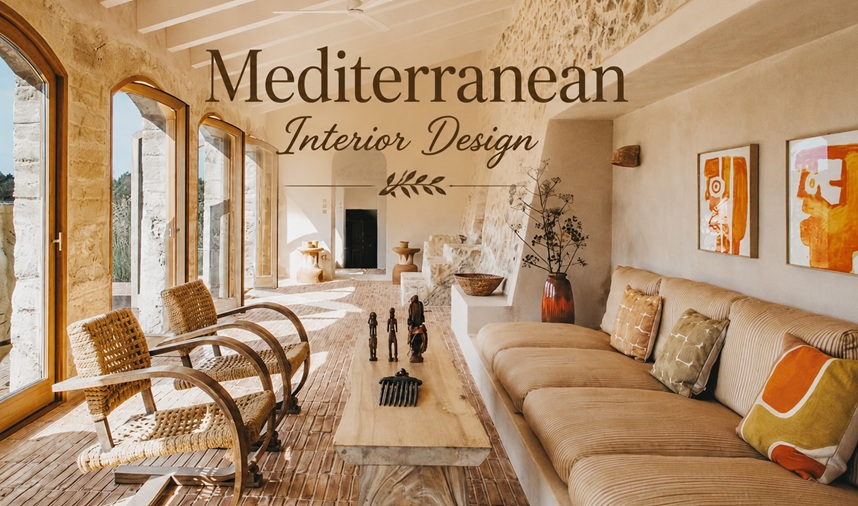
Mediterranean interior design is one of the most enduring and widely referenced aesthetics in residential design, and it is currently experiencing a significant revival — not as a nostalgic recreation of the 1990s Tuscan kitchen or the blue-and-white coastal clichés of an earlier era, but as something more refined, more grounded, and considerably more interesting than either of those interpretations ever managed to be.
Named one of the leading global design directions of the year by the 1stDibs Designer Trends Report, alongside forecasts from Engel and Völkers and Decorilla, Mediterranean interior design in its current form is about material honesty, warmth, a connection to the outdoor environment, and the slow, rooted quality of living that characterises the regions it draws from. As designer Jay Jeffers describes the modern interpretation: it is sun-washed tones, plaster walls, and ornate metalwork, but with a more grounded, earthy direction — not about adopting a look, but embracing a slower, more rooted way of living.
This guide covers the full scope of Mediterranean interior design: its origins, its defining principles, the colour palette and materials, and then the three major regional sub-styles that most homeowners are drawn to — modern Mediterranean, Spanish Mediterranean, and Tuscan Mediterranean — with specific advice on how each one translates into a real home.
What Is Mediterranean Interior Design?
Mediterranean interior design draws from the countries that border the Mediterranean Sea — Spain, Italy, Greece, Morocco, southern France, and beyond. What these countries share, despite their cultural differences, is a set of climate-driven architectural responses that have shaped domestic interiors for centuries: thick walls that keep out summer heat, arched openings that allow air to flow, terracotta floors that stay cool underfoot, and an inherent relationship between interior and exterior that treats the garden, courtyard, and terrace as extensions of the living space rather than separate outdoor areas.
The style is not a single coherent aesthetic but a family of related ones, all sharing certain core characteristics while differing significantly in character and detail. Spanish Mediterranean is warmer and more colourful, built around patterned tile, wrought iron, and arched architectural forms. Tuscan Mediterranean is earthier and more rustic, rooted in the Italian countryside tradition of stone, exposed timber, and golden-hour light. Greek and coastal Mediterranean is lighter and more minimal, defined by white plaster and brilliant blue accents. Modern Mediterranean strips away the regional specificities and builds an interior from the shared material and atmospheric qualities of all these traditions.
The current revival is specifically the modern interpretation — what designers are calling Refined Mediterranean. It is stripped of the 1990s markers (faux murals, heavy golden ironwork, dark cherry wood, cluttered accessories) and rebuilt around material honesty and atmospheric warmth. The materials carry the visual weight; the styling stays quiet. The result is a style that sits comfortably alongside warm minimalism, Japandi, and the broader earthy-textured direction of current interior design.
What Are the Core Principles of Mediterranean Interior Design?
Does Mediterranean Design Prioritise Indoor-Outdoor Living?
More than almost any other interior design style, Mediterranean design treats the boundary between inside and outside as a design opportunity rather than a structural fact. Mediterranean homes are built around the idea that the courtyard, the terrace, and the garden are as much living space as any interior room. Arched doorways opening onto a shaded courtyard, large glazed doors that fold back to merge the living room with a terrace, a kitchen that connects directly to an outdoor dining area — these are not optional additions in Mediterranean design but central to its spatial philosophy.
In practical terms, this means choosing flooring materials that can extend from inside to outside — terracotta, stone, or large-format tile — and relating the interior palette and material choices to the outdoor environment. Planting that references the Mediterranean landscape — olive trees, lavender, rosemary, agave, citrus — seen through large windows or through an open doorway becomes part of the interior experience of the room.
The seamless transition between indoor and outdoor space is one of the most powerful design moves available in any Mediterranean-influenced interior, and it costs nothing in terms of additional floor space while delivering the sense of openness and connection to the natural environment that defines the style at its best.
What Materials Define Mediterranean Interior Design?
The material palette of Mediterranean interior design is entirely natural and predominantly textural. Each material carries the evidence of its origin and its making rather than concealing it behind a smooth, uniform finish.
Limewash and plaster walls are the defining surface treatment of the Mediterranean interior. Limewash — a traditional finish made from slaked lime that has been used in Mediterranean countries for centuries — creates a soft, slightly chalky surface with visible variation in tone and texture. It catches light differently at different times of day, producing the kind of nuanced, atmospheric quality that flat paint cannot replicate. Modern limewash paints from brands including Portola, Bauwerk, and Annie Sloan replicate this effect with less technical complexity than traditional application. Plastered walls in a smooth or slightly textured finish achieve a similar quality. Both finishes photograph warmly and improve with age.
Terracotta is the most characteristic Mediterranean floor and tile material. Terracotta tiles — fired clay in warm orange-red tones — have been used in Mediterranean domestic buildings for thousands of years and remain one of the most authentic and visually distinctive flooring choices available for a Mediterranean interior. Their warmth, their slight irregularity in colour and form, and the way they absorb and release heat over the course of a day make them a genuinely functional as well as beautiful choice in climate-appropriate settings. In a contemporary interior, terracotta floor tiles with minimal grout lines and a matt or lightly sealed finish read as thoroughly current while being rooted in centuries of precedent.
Natural stone — limestone, travertine, slate, and local stone varieties — appears throughout Mediterranean interiors as flooring, wall cladding, kitchen countertops, and decorative accents. Stone is the most ancient building material in Mediterranean architecture and its presence in an interior anchors the room to something older and more permanent than contemporary manufacturing can provide.
Reclaimed and natural timber appears in exposed ceiling beams, in furniture, in door and window frames, and in built-in shelving. The timber used in authentic Mediterranean interiors is rarely pristine — it shows the marks of age, the variation of grain, and the imperfections of a material that has been used rather than preserved. Reclaimed timber beams, in particular, carry the kind of character that no new timber product can replicate.
Wrought iron is the metal of Mediterranean design — in window grilles, in stair banisters, in light fittings, in door hardware, in furniture frames. Aged or hand-forged ironwork has a visual weight and a craft quality that manufactured alternatives lack. In a modern Mediterranean interior, wrought iron is used more sparingly than in traditional interpretations but remains one of the most recognisable material signatures of the style.
Handmade ceramics, woven natural fibres — rattan, jute, seagrass — and aged brass hardware complete the material vocabulary. Every element should be chosen for its natural origin and its visible craftsmanship. The Casa Serena Living design report identifies visible craftsmanship as one of the six defining trends of the current year, and Mediterranean style has always been built on it.
What Is the Mediterranean Colour Palette?
The Mediterranean colour palette comes directly from the landscape. Approaching it from this angle — what colours exist in the physical environment of the Mediterranean region — produces a more authentic and more useful result than selecting from a list of approved hues.
The palette divides naturally into three tiers.
The first tier is the large-surface colours — walls, ceilings, and major architectural surfaces. These are the lightest and most neutral: limewashed cream, plaster off-white, sandy beige, pale greige. These tones catch and reflect natural light in the way that the thick white plaster walls of Mediterranean buildings have always done, making rooms feel simultaneously warm and luminous.
The second tier is the mid-tone colours of floors, furniture, and architectural details: terracotta, ochre, sun-baked sienna, olive green, raw warm timber. These are the colours of the earth, the clay, and the vegetation of the Mediterranean landscape. They provide depth and warmth within a room that would otherwise read as too pale, grounding the large light surfaces above in something more substantial.
The third tier is the accent colours used sparingly in textiles, tiles, and objects: muted sea blue, deep navy, burnt orange, mustard yellow, sage green. Mediterranean blue — the Aegean blue-green that sits between sea and sky — is perhaps the most evocative accent in the palette, used on joinery, in tile work, and in decorative objects but never as a dominant wall colour in a modern interpretation of the style.
The palette of the 1990s Mediterranean interior leaned toward dark golds, deep burgundies, and saturated terracotta — colours that made rooms feel heavy and potentially dated. The current approach pulls from the softer end of the same landscape: the colour of clay left out in the sun, of pale limestone, of olive leaves with their dusty grey underside, of warm beige walls that glow during golden hour. These tones feel lived-in rather than themed, and their versatility allows them to sit alongside other design influences without the room reading as a Mediterranean pastiche.
What Is Modern Mediterranean Interior Design?
Modern Mediterranean interior design is the broadest and most flexible of the three regional sub-styles covered in this guide. It draws from the shared material and atmospheric qualities of the entire Mediterranean basin — the warmth, the natural materials, the indoor-outdoor relationship — without the specific architectural references of any single country or region.
The defining characteristic of modern Mediterranean is restraint. Unlike its 1990s predecessor, which accumulated objects, accessories, and decorative details in ways that made rooms feel crowded and themed, modern Mediterranean is spare. The materials carry the visual weight. A limewashed wall, a terracotta floor, a low linen sofa, and a rattan pendant light create a room that is unmistakably Mediterranean in atmosphere without requiring any further decoration. The fewer additional objects in the room, the stronger the effect.
This intersection with warm minimalism is one of the reasons modern Mediterranean feels so current. The same principles — natural materials, material honesty, restraint in objects, warmth in palette — that define warm minimalism define modern Mediterranean. The difference is architectural character: warm minimalism tends toward clean, unadorned surfaces, while modern Mediterranean introduces the textural complexity of limewash, the irregularity of handmade tile, and the organic form of hand-thrown ceramics.
For a modern Mediterranean living room, begin with limewash or plaster walls in a warm cream or greige. Add a terracotta or large-format stone floor — or a natural fibre rug if the floor cannot be changed. Choose a low, linen-upholstered sofa with simple, curved lines. Add a rattan armchair or a wicker side table. Place a handmade ceramic vessel and a single plant — an olive tree, a trailing plant in a terracotta pot — as the only decorative additions. The room is complete. Every additional object dilutes the effect.
For a modern Mediterranean kitchen, the approach is handle-free or minimal-handle cabinetry in a warm muted tone — clay, greige, warm white — with natural stone or clay countertops, a handmade tile splashback in a simple pattern or textured finish, open shelving in natural timber for a small number of considered objects, and aged brass hardware throughout. The kitchen should feel as though it has been used for decades and improved through use, not as though it was installed last month.
Arched architectural details — arched doorways, arched window recesses, arched niches in walls — are the single most impactful structural addition to a modern Mediterranean interior, and they are increasingly achievable as an addition to existing rooms. A simple arched doorway between a hallway and a living room, achieved with lightweight plasterboard work and finished in limewash, transforms the character of both spaces at relatively modest cost.
What Is Spanish Mediterranean Interior Design?
Spanish Mediterranean interior design is the richest and most colourful of the regional sub-styles. It draws from the domestic architecture of southern Spain — Andalusia in particular — and from the design traditions that reflect the confluence of Moorish, European, and Latin American influences that shaped Spanish decorative arts over centuries.
The defining visual element of Spanish Mediterranean is patterned tile. Spanish encaustic tiles, Talavera tiles, and Zellige tiles — in geometric patterns, floral motifs, and rich colour combinations — appear on floors, on kitchen splashbacks, on bathroom walls, around fireplaces, and even on stair risers. No other Mediterranean sub-style uses colour in tile work with the same confidence and consistency. The tile is not merely decorative in a Spanish Mediterranean interior — it is structural to the room’s identity.
The arched form is more pronounced in Spanish Mediterranean than in other regional variants. Arched doorways, arched window openings, arched niches in walls, and arched ceiling details all reference the Moorish architectural tradition that left its most lasting mark on Spanish domestic building. The arch is not a decorative affectation in this context but an authentic architectural form rooted in centuries of Spanish building practice.
Wrought iron in Spanish Mediterranean is more elaborate and more prominent than in modern or Tuscan interpretations. Wrought iron banisters, window grilles, chandelier frames, and door hardware bring a dark, handcrafted weight to Spanish interiors that provides contrast against the warm plaster walls and the colourful tile work. In a hallway, a wrought iron stair balustrade against terracotta floor tiles and a limewashed wall is one of the most immediately recognisable Spanish Mediterranean compositions.
The colour palette of Spanish Mediterranean is warmer and more saturated than modern Mediterranean but more controlled than its 1990s American interpretation. Deep terracotta, saffron yellow, cobalt blue used as an accent in tile work, olive green, and warm white on walls provide the colour range. The key is that colour in Spanish Mediterranean comes primarily from materials — the tile, the ironwork, the timber — rather than from paint on walls.
Timber in Spanish Mediterranean appears in ceiling beams, in door frames, and in furniture. Spanish-influenced furniture tends toward heavier proportions than Scandinavian or Japanese-influenced pieces — solid, carved wood chairs, dark stained timber dining tables, leather and nail-head upholstery. In a modern Spanish Mediterranean interior, these heavier furniture pieces are balanced against lighter architectural surfaces and fewer additional objects, preventing the room from feeling oppressively dark or cluttered.
For a Spanish Mediterranean bedroom, consider a wrought iron bed frame — one of the most authentic Spanish bedroom elements available — against limewashed walls in a warm cream. A Talavera tile pattern used as a border around the headboard wall or on a fireplace surround introduces colour and pattern without overwhelming the space. Terracotta floor tiles, a simple woven rug, and dark timber bedside tables complete the composition.
What Is Tuscan Mediterranean Interior Design?
Tuscan Mediterranean interior design draws specifically from the domestic architecture of central Italy — from the farmhouses, villas, and rural buildings of Tuscany that have provided the most romanticised image of the Mediterranean interior for several generations of homeowners worldwide.
The Tuscan interior is earthier and more rustic than other Mediterranean sub-styles. Its characteristic materials — rough stone walls, exposed timber ceiling beams, terracotta floors, wrought iron hardware, plaster in warm golden tones — reference the agricultural landscape and the vernacular building tradition of the Italian countryside. The style is inherently unpretentious: it is the aesthetic of buildings that were built to last and to work, not to impress.
The 1990s American Tuscan kitchen — heavy iron pot racks, dark cherry cabinetry, faux mural painted walls, elaborate golden ironwork — was a maximalist parody of the authentic Tuscan interior and is worth specifically avoiding as a reference point. The authentic Tuscan room is spare and warm rather than crowded and theatrical. What gives it its character is the quality and age of its materials, not the density of its decoration.
The modern Tuscan revival is being driven by exactly this correction. As one recent analysis of the movement describes it, the modern palette pulls from the softest, most natural tones in the Tuscan landscape rather than its deepest pigments: the colour of clay left out in the sun, of pale limestone, of olive leaves with their dusty underside, of warm beige walls that glow during golden hour. These tones feel lived-in and authentic in a way that the saturated golds and deep burgundies of the 1990s Tuscan palette never quite did.
Exposed ceiling beams are the most characteristic structural element of a Tuscan interior and the one that most immediately communicates the style. Natural timber beams — whether original or added as part of a renovation — change the perceived scale and character of a room entirely. In a kitchen or a living room with a Tuscan influence, exposed beams ground the ceiling and introduce the kind of organic warmth that no paint colour or accessory can replicate. The beams should be left in a natural finish or treated with a clear or lightly pigmented oil rather than stained to an artificial colour.
Stone in a Tuscan interior appears in floors, in wall sections, and in kitchen surfaces. Travertine, limestone, and rough fieldstone are the most characteristic Tuscan stone materials. In a kitchen renovation with Tuscan influence, a stone countertop — honed rather than polished, showing the natural variation of the material — paired with simple cabinetry in a warm cream or clay tone produces a result that is simultaneously contemporary and rooted in the Tuscan tradition.
The furniture of a Tuscan interior is solid and unpretentious. A heavy farmhouse dining table in reclaimed timber, simple ladder-back or rush-seat chairs, a large stone or terracotta fireplace surround, shelving in rough-hewn timber. The pieces are made to last and to be used daily without ceremony. In a modern Tuscan interior, these heavier pieces are placed in rooms with generous natural light and light wall surfaces — the balance between the weight of the materials and the lightness of the space around them is what prevents the style from feeling dark or oppressive.
For a Tuscan Mediterranean kitchen — the room where the style is most often applied — the elements to prioritise are exposed timber beams if the ceiling allows, stone or terracotta floors, simple cabinetry in a clay or warm greige tone with aged brass hardware, a stone or honed marble countertop, and open shelving in natural timber for a small number of ceramic objects and cooking implements. Keep the accessories minimal. A terracotta pot of herbs on the windowsill, a wooden bowl on the counter, a simple ceramic pitcher. The less that sits on the surfaces, the more the materials themselves speak.
How Do You Apply Mediterranean Interior Design Room by Room?
What Does a Mediterranean Living Room Look Like?
The Mediterranean living room prioritises comfort, warmth, and a connection to the outdoor space. Seating is generous — large, low sofas in natural linen or cotton, with simple curved lines rather than sharp contemporary profiles. A low coffee table in stone, reclaimed timber, or hammered metal. A woven natural fibre rug grounding the seating arrangement.
The fireplace is the natural focal point of a Mediterranean living room, whether it is a grand stone surround in a Tuscan villa or a simple plastered arch around a wood-burning stove. The mantelpiece carries only a few considered objects — a handthrown ceramic, a candle in a simple holder, a small plant.
An arched doorway or large glazed doors opening onto a terrace or courtyard connects the living room to the outdoor space and provides the most distinctively Mediterranean spatial quality available in any room.
What Does a Mediterranean Kitchen Look Like?
The Mediterranean kitchen is built for daily use and for the pleasure of cooking. It is generous, warm, and practical rather than sleek or clinical. Natural materials throughout — stone countertops, terracotta or large-format tile floors, timber shelving — and warm artificial light that relates to the light of the cooking flame.
The most effective Mediterranean kitchen improvements, in order of impact: limewash or plaster-effect paint on the walls, terracotta or stone-look tile on the floor or splashback, aged brass or wrought iron hardware replacing standard chrome fittings, open shelving in natural timber for ceramics and frequently used items, and handmade or patterned tile as a splashback or backsplash detail.
What Does a Mediterranean Bathroom Look Like?
The Mediterranean bathroom references the hammam and the bathhouse traditions of the region — a room with spa-like calm, natural stone surfaces, and warm, diffused light. Large-format travertine or limestone tiles on floors and walls, a freestanding stone or ceramic basin, simple aged brass fixtures, and a walk-in shower with a simple fixed head and stone-effect or large-format tile on the walls.
Mosaic tile — small ceramic or stone tiles in patterns inspired by traditional Mediterranean tile work — is one of the most effective bathroom additions in a Mediterranean-influenced space. A mosaic tile floor in a shower tray, or a border of patterned Zellige tile around a bath surround, introduces the decorative richness of the style at a manageable scale.
How Do You Get the Mediterranean Look Without Renovating?
For homeowners who cannot or do not want to undertake structural changes, several surface-level interventions produce the Mediterranean atmosphere with minimal disruption.
Limewash paint or a plaster-effect paint finish applied to walls is the single highest-impact non-structural change available. It transforms the character of a room from flat and contemporary to textural and warm without touching anything structural.
Replacing standard hardware — door handles, kitchen cabinet pulls, light switches — with aged brass or wrought iron alternatives is inexpensive and immediately shifts the material character of the space.
Introducing natural textiles — linen cushion covers, a jute or sisal rug, a woven throw — brings the tactile warmth of Mediterranean materials into an existing room without requiring any structural commitment.
A terracotta pot with an olive tree or a large succulent, placed near a window or beside a door, is one of the most immediately evocative Mediterranean additions available. It connects the interior to the landscape that the style references and introduces living material in a way that manufactured accessories cannot.
Finally, editing the room — removing objects that do not contribute natural material quality or genuine function — is as important as any addition. A Mediterranean interior with too many accessories reads as thematic rather than authentic. The material quality of what remains is what carries the atmosphere.
Why Is Mediterranean Interior Design So Enduring?
The reason Mediterranean interior design has remained relevant across centuries and continues to resonate in a design landscape shaped by very different cultural and technological conditions is not that it is fashionable. It is that it is built on a response to real conditions — climate, craft, material availability, and a particular relationship between human beings and the natural environment — that remains compelling because those conditions are universal human concerns regardless of era.
Limewash walls are beautiful because they catch light in a way that flat paint does not. Terracotta floors are beautiful because the material is warm to the touch, honest about what it is, and improves with age. Stone countertops are beautiful because they are permanent, cool, and unique in their grain. These are not trend-driven preferences but responses to the inherent qualities of natural materials that human beings have recognised for as long as we have been building homes.
That is why Mediterranean interior design — in its modern, Spanish, or Tuscan form — will always feel relevant. It is built on materials and principles rather than on the preferences of a particular cultural moment. Strip away the period-specific markers, lean into the texture and warmth, and what remains is simply a very good way to make a home.