
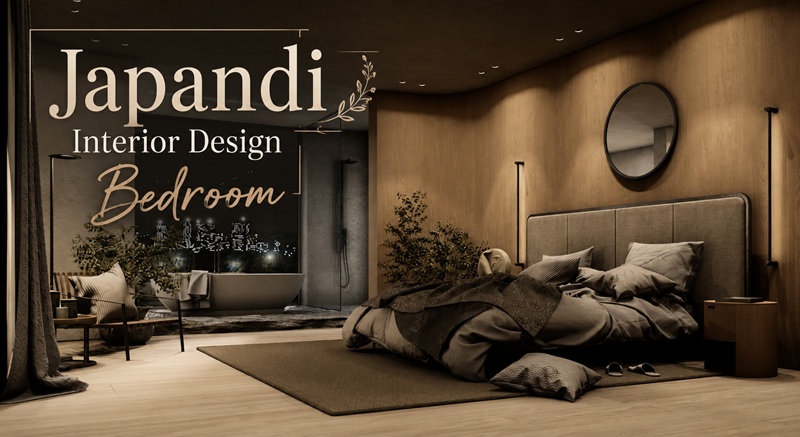
The Japandi bedroom is, at its core, a room designed for rest. Not rest as an afterthought — not a room that is primarily decorative and incidentally slept in — but a space where every decision has been made in service of calm, restoration, and the quality of daily life that a genuinely restful sleep environment supports. It is a bedroom that has been edited rather than decorated, where the absence of the unnecessary is as deliberate as the presence of what remains.
Japandi interior design has been one of the most sustained and influential design movements of the past several years, and its application to the bedroom is where its principles find their most natural expression. The bedroom is where you exhale. Japandi is the design language of exhaling.
This guide covers the full picture of Japandi bedroom design — its philosophical roots, its defining principles, the colour palette and materials, the furniture choices that make it work, how to layer textiles, how to approach lighting, and how the style sits alongside and within the character of period properties.
What Is Japandi Interior Design?
Japandi is a portmanteau of Japanese and Scandinavian — a design sensibility that emerged from recognising how deeply compatible these two traditions are despite their geographical and cultural distance. Japanese design draws from centuries of Zen Buddhist philosophy and the aesthetic worldview of wabi-sabi, which finds beauty in imperfection, impermanence, and incompleteness. Scandinavian design emerged from the functional, democratic modernism of the mid-20th century Nordic countries, shaped by long winters, limited daylight, and a commitment to the idea that beautiful, well-made objects should be available to everyone.
Both traditions arrived independently at remarkably similar conclusions. Both value natural materials over synthetic ones. Both prefer restraint over ornament. Both find beauty in objects that serve their function honestly. Both prioritise the quality of the space — how it feels to be in it — over its visual complexity. Both seek warmth without clutter and calm without coldness.
Japandi synthesises these shared values into an interior design language that is simultaneously minimal and warm, disciplined and comfortable, visually quiet and materially rich. It is sometimes described as Scandinavian design that has studied in Kyoto — the structural clarity of Nordic modernism with the philosophical depth of Japanese aesthetics overlaid.
In a bedroom context, this translates to a room that asks nothing of you when you enter it. No unresolved visual tensions, no surfaces demanding attention, no clutter communicating unfinished business. Just well-chosen natural materials, warm light, quality textiles, and space for the mind to slow down.
What Is Wabi-Sabi and How Does It Affect Japandi Bedroom Design?
Wabi-sabi is the Japanese aesthetic philosophy most central to understanding what distinguishes Japandi from mere Scandinavian minimalism. It is rooted in three Buddhist principles: nothing lasts, nothing is finished, nothing is perfect. In interior design, this translates into a preference for materials and objects that show the marks of their making and their use, rather than aspiring to machine perfection.
In a Japandi bedroom, wabi-sabi means choosing a handthrown ceramic lamp base over a factory-perfect one. It means valuing a linen bedding set that softens and creases with every wash over one that must be ironed into submission. It means seeing the grain variation in a solid oak bedside table — the knots, the colour changes, the slight unevenness of a hand-planed surface — as the most beautiful part of the piece rather than a defect to be hidden under lacquer or paint.
Wabi-sabi also explains the Japandi preference for asymmetry over symmetry. A perfectly matched pair of identical bedside tables, identically styled, has a predictability that wabi-sabi finds less interesting than two tables of different heights or materials, each chosen for its individual quality, placed in a relationship that is balanced but not mirrored. The bedroom feels human rather than arranged.
This is a meaningful distinction for homeowners who find purely Scandinavian minimalism too cold or too staged. The wabi-sabi strand within Japandi introduces a warmth and personality that strict minimalism does not permit.
What Is the Japandi Bedroom Colour Palette?
The Japandi colour palette is built from warm neutrals rather than cool ones, a distinction that matters enormously in practice and explains why Japandi bedrooms feel warmer than most minimalist interiors despite using a similarly restrained range of colours.
The dominant Japandi wall colour is greige — a warm grey-beige that sits precisely between Scandinavian cool and Japanese warmth. Reference paint shades from established ranges include Farrow and Ball’s Elephant’s Breath, Benjamin Moore’s Pale Oak, and similar warm-neutral options from other quality paint manufacturers. These shades read as almost neutral in photographs but introduce a warmth into a room that a true grey or a cool white cannot achieve.
Warm white, soft cream, and pale putty are the alternative Japandi wall choices — close to neutral but with a yellow or pink undertone that distinguishes them from the stark brilliant white of conventional minimal interiors.
The supporting palette introduces depth through accent tones rather than through colour variety. Charcoal, dark oak, deep sage, muted terracotta, and deep indigo all appear as accent colours in Japandi bedrooms, used sparingly and in service of grounding the space rather than decorating it. A charcoal linen throw at the foot of the bed. A dark walnut bedside table against a greige wall. A single ceramic object in a muted clay tone on a floating shelf. These accents provide depth without introducing the chromatic complexity that would undermine the calm of the palette.
The key distinction between the Japandi palette and the cool grey palettes of mainstream minimalism is temperature. Every colour choice in a Japandi bedroom leans warm. Cool greys, icy whites, and blue-toned neutrals are incompatible with the philosophy because they create a coldness that neither the Japanese nor the Scandinavian tradition was ever trying to achieve.
What Furniture Belongs in a Japandi Bedroom?
What Kind of Bed Frame Suits a Japandi Bedroom?
The bed is the most important object in a Japandi bedroom and the decision that most affects how the room feels. The Japandi bed is low — a platform frame that keeps the sleeping surface close to the floor, typically 20 to 40 centimetres from the floor to the top of the mattress before bedding. This low proportion is directly Japanese in origin, referencing the floor-level sleeping tradition of Japanese domestic space, and it has an immediate effect on the atmosphere of the room: low furniture grounds a space and makes it feel calm in a way that tall furniture cannot.
The material is solid natural wood — oak for a calm, lighter result, walnut for depth and drama, mango or acacia for warmth and grain variation. Lacquered or synthetic finishes are incompatible with Japandi principles regardless of their colour. The wood should show its grain, its natural tone variation, and the marks of its making. A flat, featureless surface treated to look like wood but without its material honesty does not belong in a Japandi bedroom.
The headboard should be simple or absent. A minimal slatted headboard in the same timber as the frame, a low upholstered panel in undyed linen, or no headboard at all — leaving the wall behind the bed as a quiet, uninterrupted surface — are all appropriate. An elaborate upholstered headboard with button tufting or heavy sculptural form introduces the kind of decorative assertion that Japandi actively avoids.
What Bedside Tables and Storage Work in a Japandi Bedroom?
Bedside tables in a Japandi bedroom are typically small, low, and asymmetric. A simple timber stool on one side and a wall-mounted shelf on the other, or two tables of slightly different heights and different designs, reflects the wabi-sabi preference for balanced asymmetry over mechanical matching.
Storage is one of the areas where the Scandinavian functional strand of Japandi has the most to offer. Built-in wardrobes with flush, handle-free or minimal-handle doors eliminate the visual complexity of freestanding furniture and keep the room’s surfaces clean and uninterrupted. Where built-in storage is not possible, a freestanding wardrobe in a painted or natural timber finish with simple recessed handles maintains the principle of visual quietness.
Open shelving has a place in a Japandi bedroom but must be edited severely. The Japandi principle for open display is a maximum of five objects per shelf, each chosen for its material quality and its relationship to the objects around it. A shelf with a handthrown ceramic vase, a small stack of books, and a single plant is contributing to the room. A shelf accumulated with objects over time, each individually meaningful but collectively producing visual noise, is working against everything the bedroom is trying to do.
What Other Furniture Belongs in a Japandi Bedroom?
A low bench at the foot of the bed is one of the most characteristic and practical additions to a Japandi bedroom. In timber, upholstered in undyed linen or wool, or in a combination of both, it provides a surface for placing folded clothing, for sitting while dressing, and for anchoring the end of the bed visually. It should be proportionate to the width of the bed and low enough not to interrupt the horizontal emphasis of the room.
A single low armchair or floor cushion in a corner of the room gives the space a secondary function — somewhere to sit and read or reflect — without adding the furniture weight of a conventional reading chair. Rattan or wicker chairs with simple cushions, or low armchairs with a clean profile in natural fabric, suit the aesthetic without competing with the bed for visual dominance.
Everything else should be questioned. A Japandi bedroom does not need a dresser, a television, a vanity, or supplementary decorative furniture unless each item serves a clear function that cannot be served by another piece already present. The editing principle of Japandi is not minimalism for its own sake but minimalism in service of the specific function of the bedroom, which is rest.
What Textiles and Bedding Work in a Japandi Bedroom?
Textiles are the primary source of warmth and physical comfort in a Japandi bedroom, and they are where the Scandinavian hygge strand of the style is most directly expressed. The discipline applied to furniture and objects is balanced by generosity in bedding and layering — a Japandi bed is not sparse, it is thoughtfully rich in textile quality.
Linen is the quintessential Japandi bedding material. Natural, undyed, or lightly pigmented in warm neutral tones — oatmeal, warm white, pale stone, soft sage — linen bedding softens and improves with every wash, creasing in a way that looks lived-in rather than neglected, becoming more beautiful through use. This is the wabi-sabi principle applied directly to the surface you sleep on.
The layering of the Japandi bed is restrained in number but generous in quality. A fitted sheet, a flat sheet or duvet in natural linen or cotton, and a single wool or chunky-knit throw draped across the foot of the bed — this is sufficient. Two to three pillows per side, not the decorative pillow fortress of conventional Western bedroom styling. A single large cushion in a contrasting texture — a bouclé or a woven wool cover — can anchor the arrangement without introducing decorative complexity.
The floor covering in a Japandi bedroom is typically a natural fibre rug in wool, jute, seagrass, or cotton. Positioned to extend beyond the sides and foot of the bed, giving a soft landing surface on both sides when rising in the morning, it adds warmth, texture, and acoustic softness without introducing pattern or colour that competes with the palette of the room.
Curtains in a Japandi bedroom are simple and natural — unlined or lightly lined linen or cotton in a tone close to the wall colour, hanging in a simple gathered or rod pocket configuration from a ceiling-height or near-ceiling-height rod. The simplicity of the curtain treatment is part of the visual quietness of the upper portion of the room, which Japandi keeps as clear and uninterrupted as possible.
How Should a Japandi Bedroom Be Lit?
Lighting in a Japandi bedroom follows a single organising principle: warm, layered, and never harsh. Every bulb in a Japandi bedroom should be at 2700K colour temperature — the warm amber tone that makes natural materials glow and that creates the kind of quiet evening atmosphere in which a room dedicated to rest should be experienced. Cool white bulbs, even at low wattage, produce a light quality that is incompatible with the warmth the style requires.
The overhead light fixture in a Japandi bedroom is typically a paper pendant lamp — a Noguchi Akari-style rice paper lantern or a similar diffused shade that produces soft, ambient light rather than a directed beam. Paper and natural fibre pendants scatter light gently across the room, avoiding the hard shadows and bright spots of exposed bulbs or directional fittings. They also relate materially to the natural material palette of the room in a way that glass or metal shades do not.
Bedside lighting is the most-used light source in a bedroom and the one that most directly affects the atmosphere of the room in the evening. A small ceramic base lamp with a natural linen shade, or a wall-mounted reading light that provides directed light for reading without illuminating the whole room, are the most appropriate bedside options. The goal is light that is controllable — bright enough for reading when needed, dimmable to a warm ambient glow for the period before sleep.
The concept of ma — negative space, or intentional emptiness — applies to lighting as much as to objects. Not every corner of the room needs to be illuminated. The dark corners of a Japandi bedroom are not failures of lighting design; they are part of the atmospheric depth that makes the room feel calm and dimensional rather than evenly lit and flat.
What Natural Materials Define a Japandi Bedroom?
The material vocabulary of a Japandi bedroom is strictly natural. This is not a stylistic preference but a philosophical one — the Japandi commitment to material honesty means that synthetic materials, regardless of how well they mimic natural ones, do not belong in the space.
Wood is the primary structural material — in the bed frame, the bedside tables, the storage, the floor. Ash, birch, oak, walnut, mango, and teak all appear in Japandi interiors. The choice between lighter and darker woods is partly a matter of personal preference and partly a question of the room’s light conditions — pale ash and birch work well in rooms with limited natural light, while walnut and darker oak suit brighter rooms where their depth does not make the space feel heavy.
Stone surfaces appear in Japandi bedrooms as decorative objects and as material accents — a marble or slate tray on the bedside table, a ceramic stone-finish pot for a plant, a rough-hewn stone object on a floating shelf. Stone is not typically used as a structural surface in bedrooms but its presence as an accent material introduces the earthy, grounding quality that completes the natural material palette.
Ceramics — particularly handmade, unglazed or partially glazed pieces with visible throwing marks — are the primary decorative objects in a Japandi bedroom. A single handthrown pot on the windowsill, a ceramic lamp base, a small bowl on the bedside table for keys or jewellery. Each piece should carry evidence of its making: irregular edges, glaze variation, the visible spiral of the potter’s wheel. The factory-perfect ceramic object has no place in a room shaped by wabi-sabi.
Plants bring the natural world directly into the bedroom and are one of the most consistently recommended Japandi additions. A single well-chosen plant in a simple ceramic or terracotta pot — a small olive tree, a snake plant, a trailing pothos — contributes organic form, living movement, and a connection to the outdoor environment that no manufactured object can replicate.
How Does Japandi Design Work in a Period Bedroom?
Georgian and Victorian bedrooms present an interesting design context for Japandi, because the architectural vocabulary of these buildings — cornicing, ceiling roses, sash windows, original fireplaces, panelled doors — carries strong historical character that a purely contemporary design style might feel incongruent against.
In practice, the combination of Japandi interior design and period architecture often works better than either approach used alone. Georgian and Japanese design share a commitment to proportion, craftsmanship, and the quality of materials. The discipline of Japandi editing — the removal of unnecessary objects, the insistence on natural materials, the warm restrained palette — actually suits period rooms well because period rooms were not designed to be cluttered. The Georgian bedroom in its original form was a spare, well-proportioned room where quality of material and proportion of space were the primary design values.
The practical approach is to retain and celebrate the period architecture rather than concealing it. Original cornicing, sash windows, a cast iron fireplace, and panelled doors are not obstacles to a Japandi bedroom — they are the room’s strongest architectural assets. The Japandi interior sits within this architectural framework rather than competing with it.
The fireplace in a period bedroom, even a non-functional one, provides exactly the kind of natural focal point that Japandi requires — a single object that anchors the room and around which the minimal furniture arrangement makes spatial sense. A simple cast iron grate, a small handthrown ceramic object on the mantelpiece, and nothing else.
The colour palette of Japandi translates naturally into period rooms. A greige or warm white on walls and ceiling, taken consistently across the ceiling rose and cornicing rather than picking them out in a contrasting white, creates a colour-drenched effect that feels considered and modern while relating naturally to the warm tones of the building’s materials.
The only element that sometimes requires careful handling is furniture height. The low platform beds central to Japanese-influenced Japandi design can feel disproportionately low in a tall Georgian room where the ceiling height calls for furniture that fills more of the vertical space. A bed frame with a slightly higher profile — still modest, still simple, still in natural timber — may feel more proportionally correct in a room with high ceilings than the very lowest Japanese-influenced frames.
What Are the Key Principles of a Japandi Bedroom Summarised?
A Japandi bedroom is defined by a small set of principles applied consistently rather than a checklist of specific objects or styles.
Every object must earn its presence. The editing question for a Japandi bedroom is not what to add but what to remove. If an object does not serve a clear function or contribute genuine material beauty, it does not belong.
Every material must be natural. Wood, linen, cotton, wool, stone, ceramics — these are the materials of a Japandi bedroom. Synthetic alternatives, however convincing, undermine the honesty that the philosophy requires.
The palette must be warm. Greige, warm white, oatmeal, sage, charcoal — always warm, never cool. The temperature of the colour is as important as the tone.
The light must be warm and layered. 2700K throughout, diffused rather than directed, controlled rather than uniform.
The floor must be clear. A Japandi bedroom with objects on the floor is a Japandi bedroom in which the editing is unfinished.
The upper half of the room must be quiet. Clear walls above the bed, a simple ceiling, a natural pendant light. The eye should be able to rest at the top of the room as easily as at the bottom.
Most importantly, the room should feel like a place designed for the specific human experience of sleeping, resting, and restoring. A Japandi bedroom that achieves this is not just stylistically successful — it is doing exactly what a bedroom should do.